
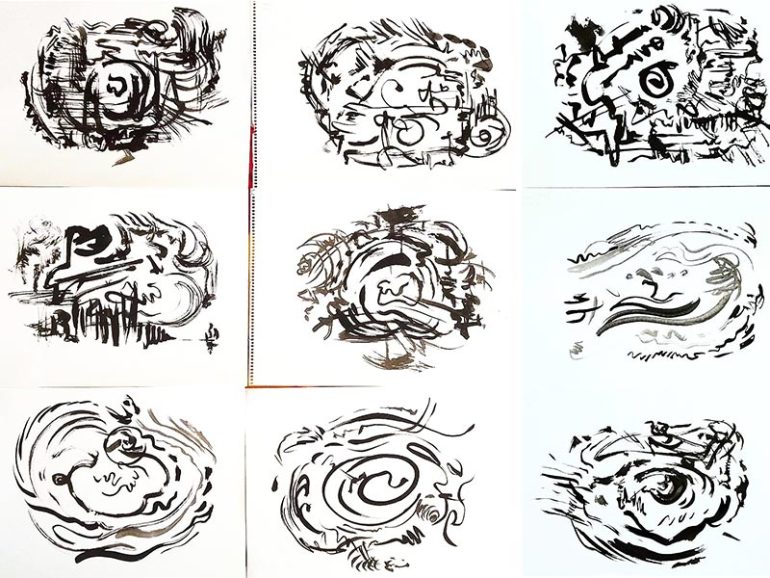
We are delighted to share something a little different today. Our Beginners’ Drawing tutor Monika Cilmi has been working on a fascinating personal art project, and she was kind enough to share it with us in the hope that it might spark some curiosity and creative thinking in our students.
The idea at the heart of Monika’s project is a simple but intriguing one. She listens to a spoken language she does not understand, and while listening, she draws continuously for the entire duration of the audio. There are no words to follow, no meaning to translate. Instead, the drawing responds entirely to rhythm, breath, pauses, and the rise and fall of sound. The result is something quite extraordinary: a series of gestural ink drawings that feel genuinely different from one another, not because of a change in style or technique, but because each language produced a different physical response in the artist making the mark.
So far Monika has worked with Hebrew, Irish Gaelic, and Chinese (Cantonese), and the differences between the resulting drawings are striking. The Hebrew drawing has an angular, compressed energy, dense with collision and structure. The Irish Gaelic drawing feels more circular and atmospheric, full of spiralling movement and breath. The Chinese drawing is altogether more flowing and spacious, with longer, calmer lines and a greater sensitivity to silence.
It is a wonderful reminder that drawing is not just a visual activity. It is a whole-body experience, shaped by what we hear, feel, and respond to in any given moment. You don’t need to be working on a formal project to take something from this idea. Next time you sit down to draw, why not put some music on and notice how it affects your marks? Or try drawing in silence and see how that feels different too.
We love that Monika continues to push her own creative boundaries alongside her teaching, and we hope this gives you plenty to think about!
Monika’s Blog and Artwork
Core Concept
This project explores how listening to a language the artist does not understand can generate drawing as an embodied act. Language is approached not through meaning, but through rhythm, breath, pauses, and intensity.
Conceptual Framework
The project brings together two fields: – Drawing as a bodily, performative act driven by listening – Language as sound, rhythm, and cultural vibration rather than semantic meaning
Process
Phase 1: Listening and Drawing The artist listens to a spoken language they do not speak. While listening, they draw continuously for the full duration of the audio. The drawing is uninterrupted, intuitive, and guided by rhythm, breath, silence, and tonal shifts rather than by words or translation.
Phase 2: Rest The completed drawing is left to rest for a period of time. This pause allows distance from the act of listening and marks a transition from gesture to reflection.
Initial Series Proposal
Series I: Three Languages Three spoken languages the artist does not speak. One drawing and one folded shape per language. Consistent duration, format, and materials.
Research Significance
The project positions drawing as a form of listening. It contributes to contemporary artistic research by exploring non-verbal communication, embodied translation, and the emergence of form through sound and movement.
These first experiments already demonstrate distinct forms of listening. The drawings do not feel like a repeated personal style applied to different languages, but rather like different bodily responses emerging through listening.
Observations on First Language Drawing
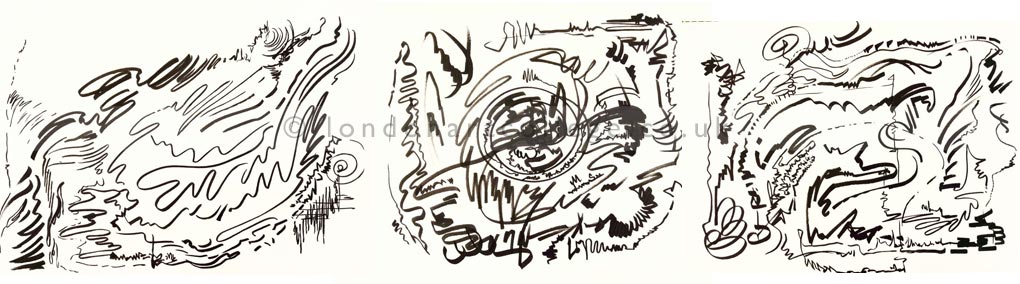
Overall Observation
All three drawings share gestural intelligence, rhythmic variation, sensitivity to pressure, and awareness of pause and acceleration. There is already a coherent visual language emerging, yet each drawing possesses a distinct internal energy.
Hebrew
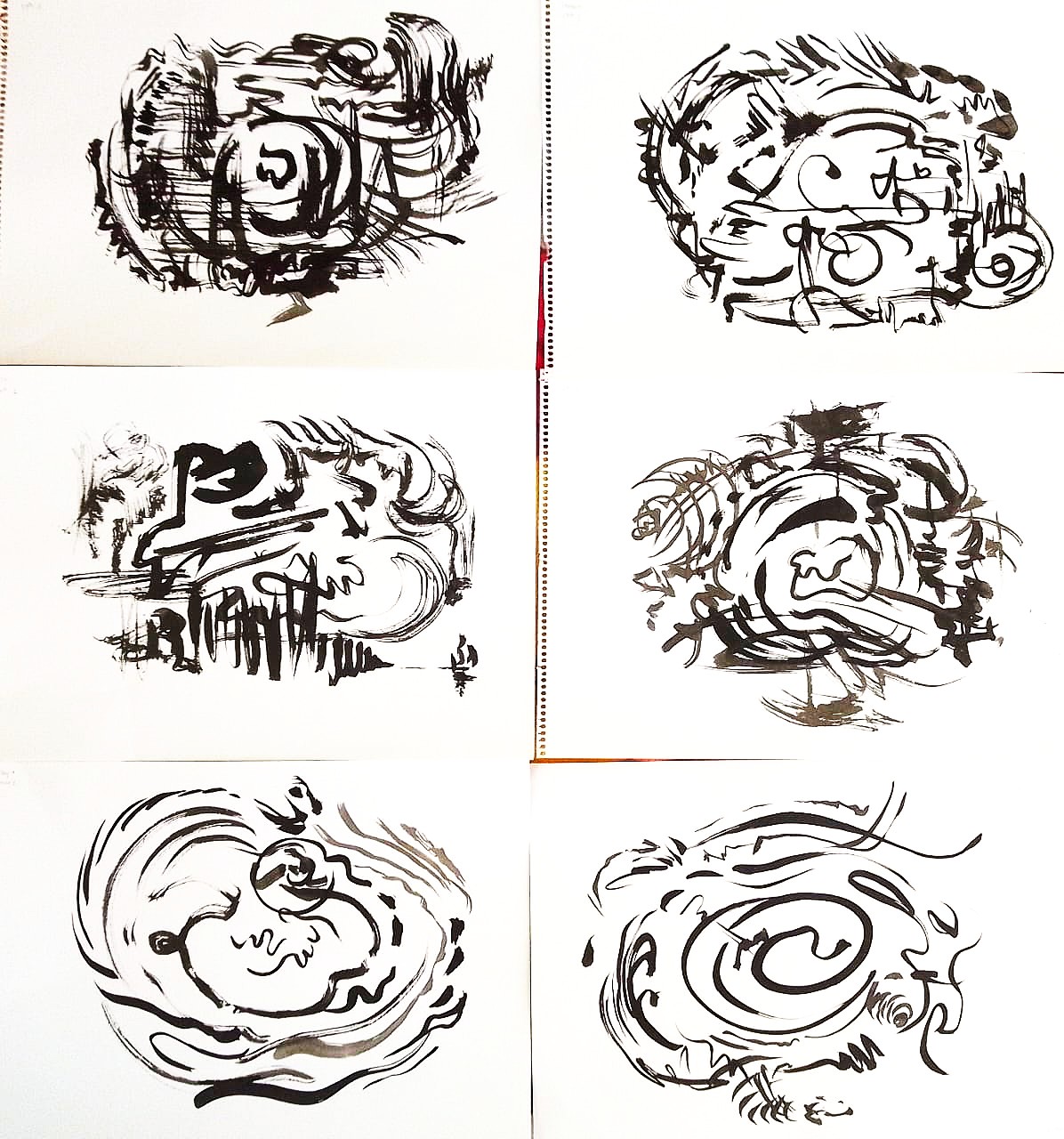
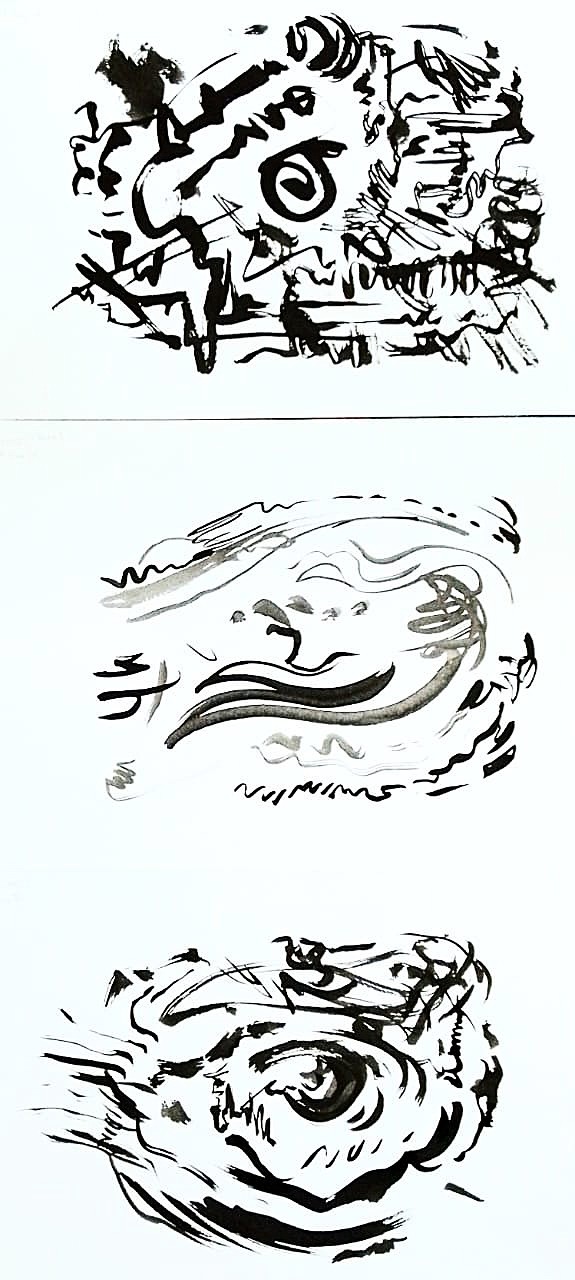
The Hebrew drawing feels fragmented, angular, dense, and interrupted. There is tension, compression, and sudden directional changes. The marks often collide, break, and compress into vertical structures. The drawing appears to negotiate resistance and contains an architectural quality. It feels closest to ‘language as structure’. The page is highly activated with very little silence.
Irish Gaelic
The Irish Gaelic drawing feels circular, turbulent, spiralling, and centralised. The circular movement in the centre creates a sense of resonance and breath. Compared to the Hebrew drawing, it is less fragmented and more atmospheric and rotational. It feels closest to ‘language as breath and resonance’. Emotionally, it feels more open.
Chinese (Cantonese)
The Chinese drawing feels spacious, flowing, and continuous. There is confidence in empty space, longer rhythmic lines, and sustained movement. Compared to the others, there is less collision and density and more glide and modulation. It feels closest to ‘language as movement’. The line becomes calmer, more economical, and more sensitive to pause.
Important Research Observation
The key question is not which drawing is strongest aesthetically, but how each language produced a different bodily response through listening. The differences are already substantial and validate the direction of the research.
Emerging Bodily Responses
Hebrew: tension, structure, interruption. Irish Gaelic: resonance, vortex, breath. Chinese: flow, continuity, spacing.
Final Reflection
These works already feel like the beginning of a serious body of research rather than isolated experiments. There is coherence, sensitivity, conceptual clarity, and bodily intelligence present. The key now is patience, consistency, and allowing the work to develop gradually.
If you would like to receive a roundup of all of our blog posts once a week to keep you inspired in your inbox, why not sign up to our newsletter. You can access our sign up at the top of our page. If you are a London Art College student and you would like your artwork featured here, drop us a line at any time.
