
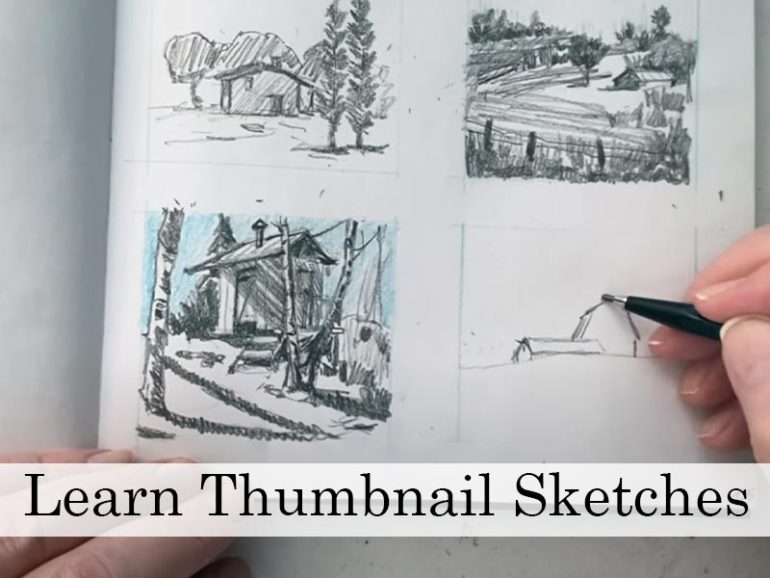
If you have ever sat in front of a blank page unsure where to start, thumbnail sketches might be just what you need. They are quick, rough and small (hence the name), but they’re one of the most useful tools an artist can have in their sketchbook.
This week we are focusing on thumbnail sketching for composition planning. A simple habit that can make a big difference to your artwork, no matter your style, subject or medium.
Here’s a great YouTube video to get you started
This video walks you through what thumbnails are, how to create them, and why they are so helpful for planning your artwork. The video is short and practical, so it’s easy to follow and apply straight away.
Why Use Thumbnails?
Thumbnail sketches are used by artists of all levels – from complete beginners to professionals planning large-scale paintings, graphic novels, or illustration spreads. And there’s a good reason for that.
They help you:
- Work out ideas quickly without committing to a full drawing
- Explore different compositions and viewpoints
- Balance your image before getting bogged down in detail
- Spot problems early before you waste time reworking a larger piece
- Build confidence when you’re unsure where to begin
You don’t need to make them perfect – in fact, they’re not supposed to be. The goal is speed and exploration, not polish.
How to Create a Thumbnail Sketch
1. Draw a few small rectangles
Use a ruler or freehand it – around 2″ x 3″ is a good size. Try to match the format of your final piece (portrait, landscape, square).
2. Block in basic shapes
Use very simple shapes to place your main subject(s). Don’t worry about detail—just rough placement.
3. Try different ideas
Move things around. Shift your focal point. Zoom in. Zoom out. Try high or low horizons. Do 4–6 quick versions.
4. Look at what works
Step back and choose the composition that feels strongest. Now you’re ready to begin your final piece with clarity and confidence.
Mini Composition Challenge
Choose a simple subject – a vase, a tree, a landscape, a corner of your room etc.
Now:
- Draw six small thumbnail boxes in your sketchbook.
- Explore different compositions for the same subject in each box.
- Play with space, direction, cropping, and balance.
- Once you’ve done all six, choose your favourite and redraw it as a full sketch.
You’ll be surprised how much more confident your main drawing feels when you’ve planned it this way first.
Try It for Any Medium
- Illustrating children’s books? Thumbnails help you plan page layout and pacing.
- Working in watercolour or oils? Plan your lights and darks before you start painting.
- Drawing from life? Use thumbnails to quickly test angles or viewpoints before committing.
Thumbnails are just as useful for pencil sketching as they are for complex finished work. They are not just a planning tool, they are a thinking tool. We hope this has encouraged you to give thumbnail sketching a try. It might seem like a small step, but it can have a big impact on your work.
If you would like to receive a roundup of all of our blog posts once a week to keep you inspired in your inbox, why not sign up to our newsletter. You can access our sign up at the top of our page. If you are a London Art College student and you would like your artwork featured here, drop us a line at any time.
